Arrays Explained — How Do They Work in Memory?
They seem simple, but understanding how they work internally helps us write more efficient code.
ᅠ 📘 Engineering Notes | From Concepts to Code — Post 20 ᅠ Arrays are one of the first data structures we learn in programming.
They seem simple, but understanding how they work internally helps us write more efficient code.
Let's explore arrays using Java examples. ᅠ 1️⃣ What Is an Array?
An array stores multiple elements of the same type in a fixed-size structure.
In Java:
int[] numbers = {10, 20, 30, 40, 50};
Each element has an index, starting from 0.
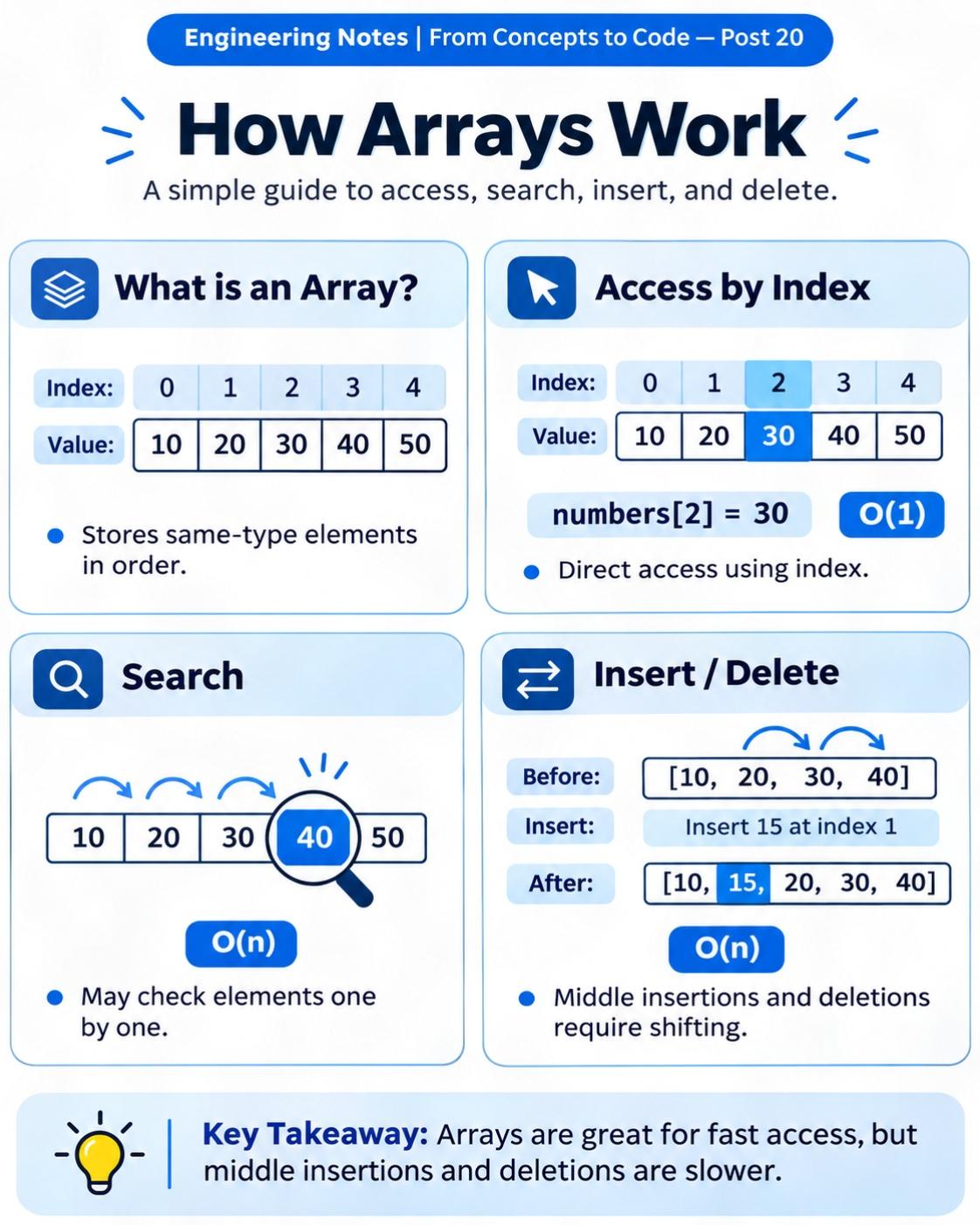
Index: 0 1 2 3 4 Value: 10 20 30 40 50
We can access an element directly using its index. ᅠ 2️⃣ How Do Arrays Work in Memory?
Java arrays store their elements in an indexed sequence.
For primitive arrays like int[], values are stored in a fixed-size array object.
Because each element has a known position, Java can access it directly using its index.
Example:
System.out.println(numbers[2]);
Output: 30
Time Complexity: O(1)
We don't need to check previous elements to access index 2. ᅠ 3️⃣ Searching an Array
Imagine searching for the value 40.
If the array isn't sorted, we may need to check elements one by one.
Example:
for (int num : numbers) { if (num == 40) { System.out.println("Found"); break; } }
Worst-case Time Complexity: O(n)
For a sorted array, binary search can reduce search time to O(log n). ᅠ 4️⃣ Inserting and Deleting
Java arrays have a fixed length, so we cannot directly increase or decrease their size.
However, we can insert or remove logical elements within available capacity by shifting values.
For example:
Before: [10, 20, 30, 40] Insert 15 at index 1 After: [10, 15, 20, 30, 40]
Elements must shift to make space.
Similarly, deleting an element may require shifting the remaining elements.
Worst-case Time Complexity: O(n) ᅠ 5️⃣ Time Complexity
• Access by index → O(1) • Search (unsorted) → O(n) • Update by index → O(1) • Insert in middle → O(n) • Delete from middle → O(n)
Arrays are excellent for fast indexed access, but inserting and removing elements can be expensive. ᅠ My Key Takeaway
Choosing a data structure isn't just about storing data.
It's about understanding which operations our application performs most frequently.
Arrays are a great choice when fast indexed access matters and the size is known.
Sometimes, simple data structures are exactly what we need. ᅠ What's one situation where you'd choose an array over a linked list? ᅠ #DataStructures #Algorithms #Java #SoftwareEngineering #DSA