⚡ How Do Database Indexes Make SQL Queries Faster?
Imagine building an e-commerce application with millions of products.
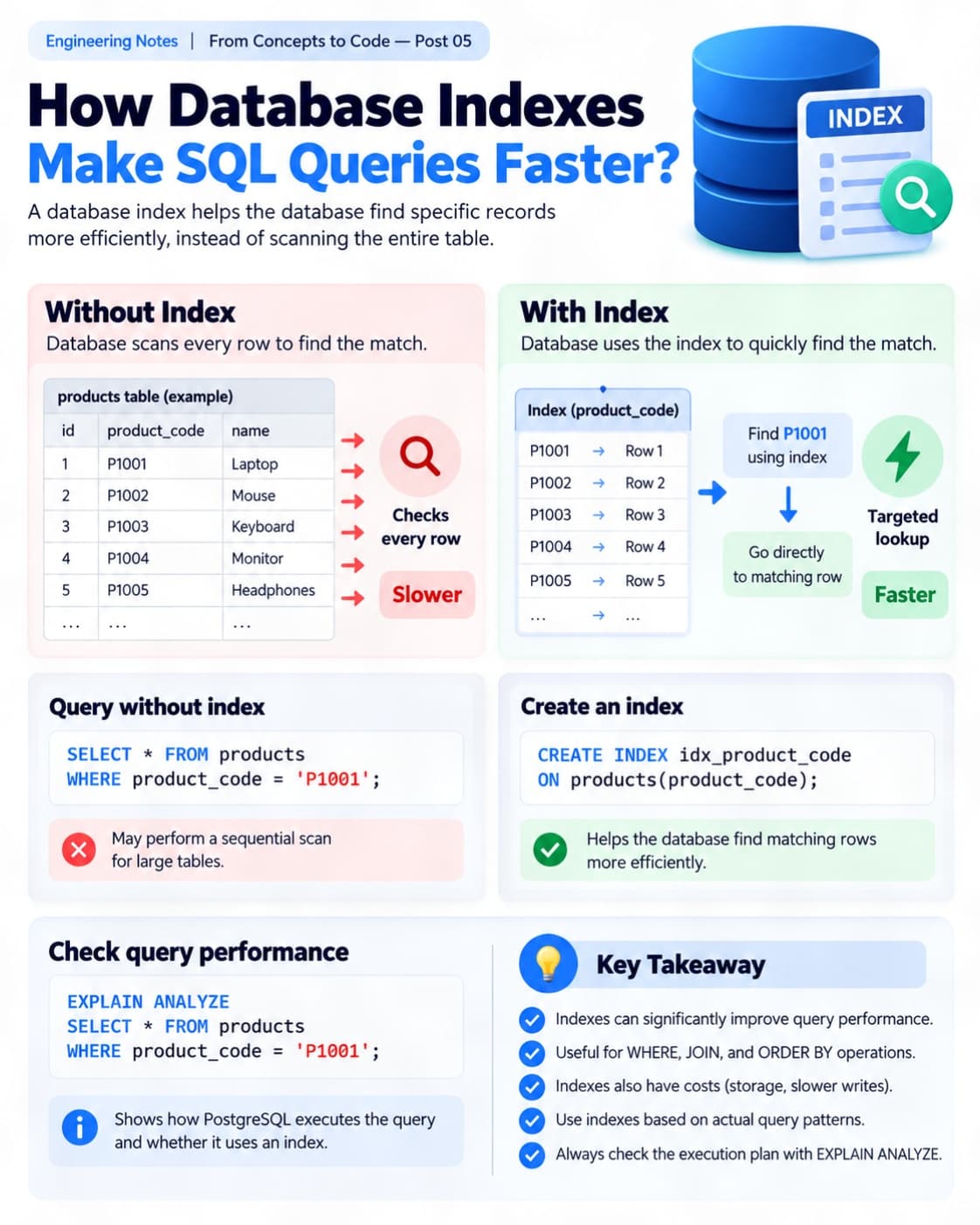
ᅠ 📘 Engineering Notes | From Concepts to Code — Post 05 ᅠ Imagine building an e-commerce application with millions of products.
A customer searches for a product, but the results take several seconds to load.
Why is the query slow? 🤔
One possible reason is missing database indexes.
Let's break it down! 👇 ᅠ 1️⃣ What Is a Database Index? 📚
An index helps the database find records efficiently.
Think of it like a book's index. Instead of reading every page, you can quickly locate the information you need. ᅠ 2️⃣ Without an Index 🐢
Imagine a products table with 1 million records.
SELECT * FROM products WHERE product_code = 'P1001';
Without a suitable index, PostgreSQL may perform a sequential scan, checking rows to find matching data.
This can be expensive for large tables. ᅠ 3️⃣ With an Index 🚀
Let's create an index:
CREATE INDEX idx_product_code ON products(product_code);
PostgreSQL can use this index to locate matching rows more efficiently.
✅ Faster lookups for suitable queries ✅ Less unnecessary scanning ✅ Better performance for frequent searches
The query planner decides whether using the index is beneficial. ᅠ 4️⃣ When Are Indexes Useful? 🔍
Indexes can help with columns frequently used in:
✅ WHERE conditions ✅ JOIN operations ✅ ORDER BY clauses ✅ Search and filtering operations
For example, indexing customer_id in an orders table may speed up customer order lookups. ᅠ 5️⃣ Do Indexes Always Help? ⚠️
Not always!
Indexes have trade-offs:
❌ Require extra storage ❌ Add overhead to INSERT, UPDATE, and DELETE ❌ Unnecessary indexes can slow writes
Creating an index on every column isn't a good practice. ᅠ 6️⃣ How To Check Query Performance? 📊
PostgreSQL provides:
EXPLAIN ANALYZE SELECT * FROM products WHERE product_code = 'P1001';
It executes the query and shows its execution plan and timing.
You can check whether PostgreSQL uses a Sequential Scan or Index Scan. ᅠ 💡 My Key Takeaway
Database performance isn't just about writing SQL that works.
It's about understanding how queries execute.
Well designed indexes can significantly improve performance, but they should be selected based on actual query patterns and execution plans.
Good database design balances read speed, write performance, and storage. ᅠ 💬 Have you optimized a slow SQL query using indexes? What was your experience? ᅠ #SoftwareEngineering #PostgreSQL #SQL #DatabaseOptimization #BackendDevelopment