Server vs Client Components — How Do They Work in Next.js?
Next.js allows us to handle server-side operations while keeping interactive features on the client.
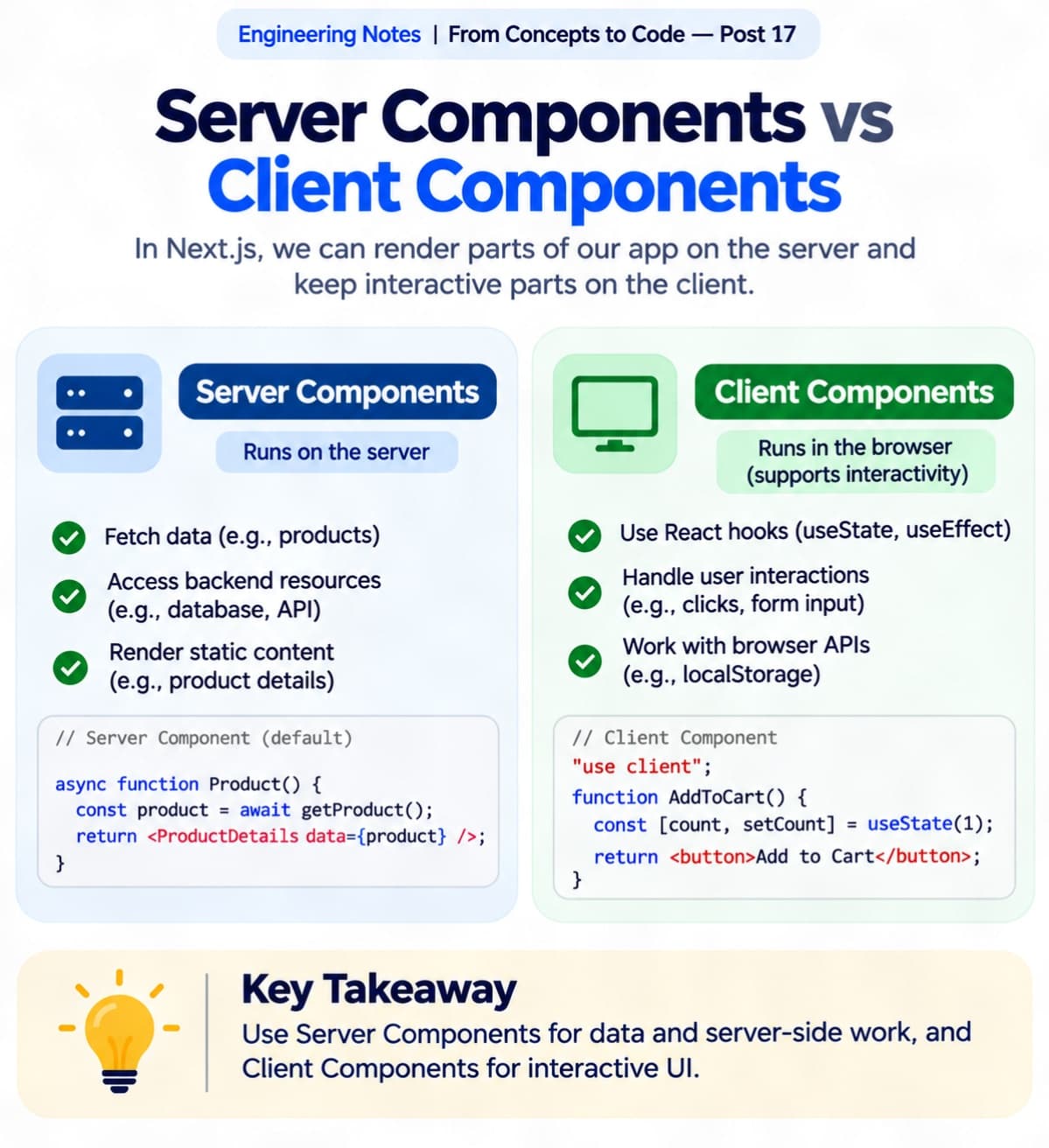
ᅠ 📘 Engineering Notes | From Concepts to Code — Post 17 ᅠ When I started working with Next.js, one interesting concept was the difference between Server Components and Client Components.
Next.js allows us to handle server-side operations while keeping interactive features on the client.
But when should we use each? ᅠ 1️⃣ Server Components
In the Next.js App Router, Server Components are used by default.
They allow us to fetch data and render content on the server.
For example, an e-commerce product page can fetch product details directly on the server.
Benefits: • Access to server-side data sources • Less client-side JavaScript • Keep sensitive operations on the server ᅠ 2️⃣ Client Components
Client Components are useful when we need user interaction or browser features.
We mark them using "use client".
Example:
"use client";
import { useState } from "react";
export default function Counter() { const [count, setCount] = useState(0);
return ( <button onClick={() => setCount(c => c + 1)}> Count: {count} </button> ); }
Client Components support: • React hooks like useState • Event handlers • Browser APIs ᅠ 3️⃣ Real-World Example
Think about an e-commerce application.
Server Components: • Product details • Server-side data fetching
Client Components: • Add to Cart button • Quantity selector • Interactive filters
We don't need to make an entire page a Client Component just because one button needs interaction.
Also, Client Components can be prerendered on the server for the initial page load. ᅠ My Key Takeaway
Good frontend architecture is about choosing the right component for each responsibility.
Use Server Components for server-side work and Client Components when interaction is needed.
Small decisions like these help us build more efficient and maintainable applications. ᅠ How do you decide between Server and Client Components in your Next.js projects? ᅠ #NextJS #ReactJS #SoftwareEngineering #FrontendDevelopment #WebDevelopment