Time vs Space Complexity — Why Does Big O Matter?
Two different algorithms might produce the same result, but one could be much more efficient than the other.
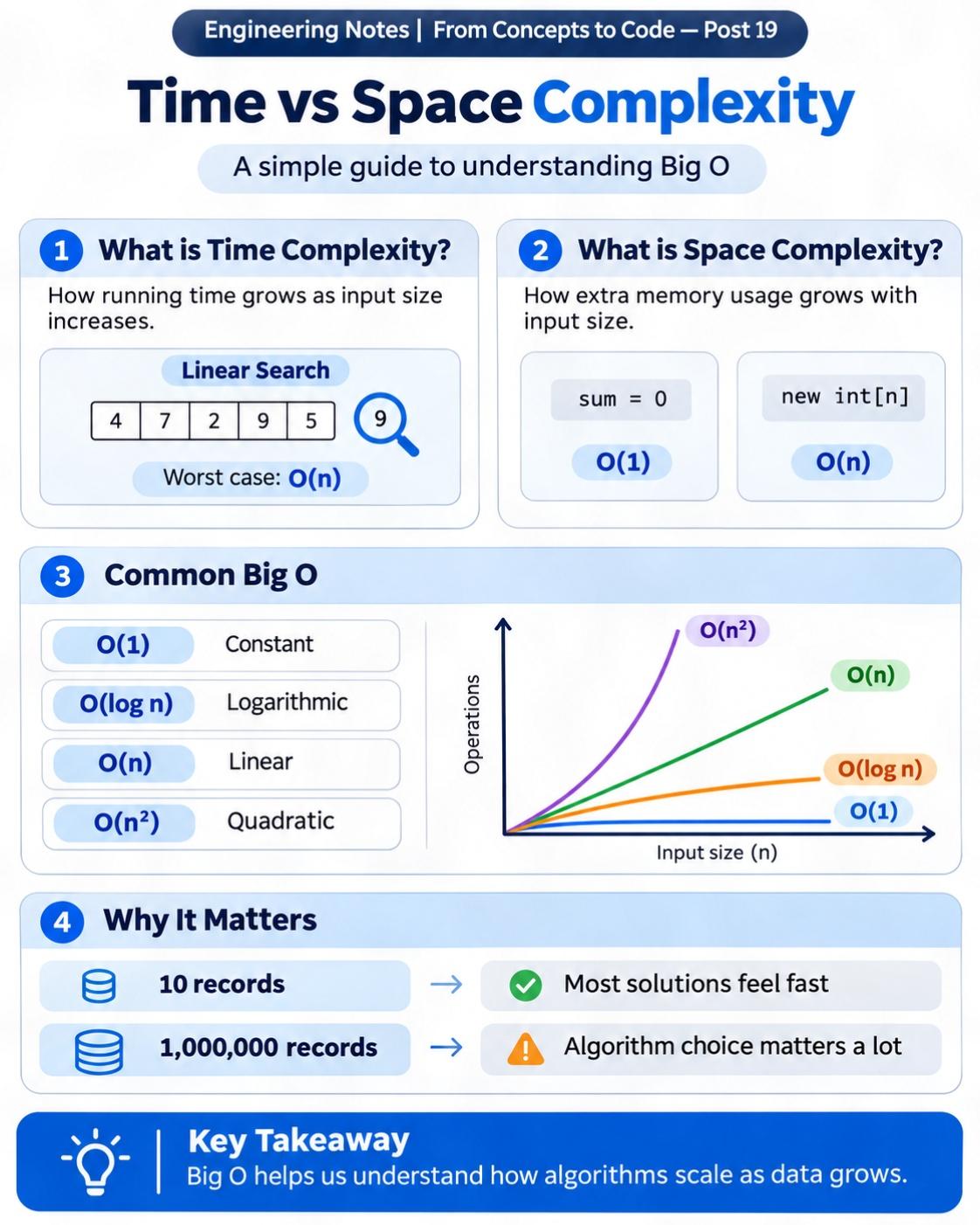
ᅠ 📘 Engineering Notes | From Concepts to Code — Post 19 ᅠ When solving a programming problem, finding a working solution is only the first step.
Two different algorithms might produce the same result, but one could be much more efficient than the other.
That's why understanding Time and Space Complexity is important.
Let's look at a simple example. ᅠ 1️⃣ What Is Time Complexity?
Time complexity describes how an algorithm's running time grows as the input size increases.
Imagine searching for a number in an array.
Java example:
int[] numbers = {10, 20, 30, 40, 50};
for (int num : numbers) { if (num == 40) { System.out.println("Found!"); break; } }
In the worst case, we may need to check every element.
Time Complexity: O(n)
If the array size doubles, the number of checks could roughly double. ᅠ 2️⃣ What Is Space Complexity?
Space complexity describes how an algorithm's memory usage grows with the input size.
For example:
int[] copy = new int[n];
This creates an additional array containing n elements.
Extra Space Complexity: O(n)
But if we only use a few variables, regardless of input size:
int sum = 0;
Extra Space Complexity: O(1)
The amount of additional memory stays constant. ᅠ 3️⃣ Common Big O Notations
Here are some common complexity classes:
• O(1) — Constant • O(log n) — Logarithmic • O(n) — Linear • O(n log n) — Linearithmic • O(n2) — Quadratic
For example, binary search runs in O(log n) time when searching sorted data.
A simple linear search takes O(n) time in the worst case. ᅠ 4️⃣ Why Does It Matter?
Imagine working with 10 records.
Even an inefficient algorithm might feel fast.
But what happens when we have 1 million records?
As the input grows, the difference between algorithms becomes much more noticeable.
Understanding complexity helps us choose solutions that scale better. ᅠ My Key Takeaway
Big O helps us understand how algorithms scale, rather than focusing only on execution time for one input.
A good solution isn't always the one with the shortest code.
It's the one that balances performance, memory usage, and readability for the problem we're solving. ᅠ When solving coding problems, do you usually think about time complexity first or space complexity? ᅠ #DataStructures #Algorithms #BigONotation #Java #SoftwareEngineering