Understanding Array Operations in Java
Arrays are one of the first things we learn in programming, but I think it's useful to understand how different operations affect performance.
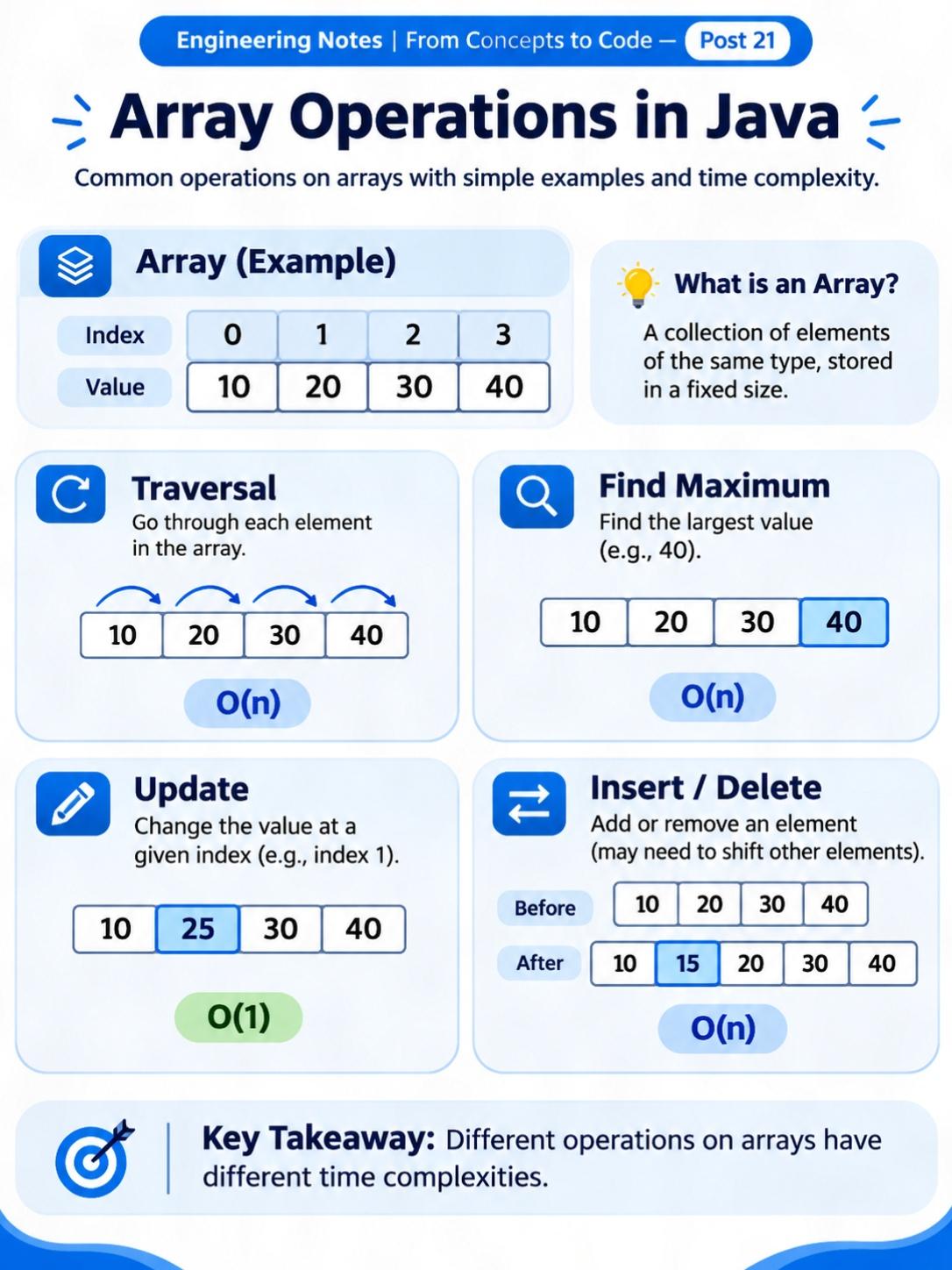
ᅠ 📘 Engineering Notes | From Concepts to Code — Post 21 ᅠ As I continue learning Data Structures and Algorithms, I've been spending some time understanding basic array operations in Java.
Arrays are one of the first things we learn in programming, but I think it's useful to understand how different operations affect performance. ᅠ Here are a few things I've been learning. ᅠ 1️⃣ Traversal
Going through each element in an array.
For example, printing all the numbers in an array.
Time Complexity: O(n) ᅠ 2️⃣ Finding the Maximum
Finding the largest value by comparing elements one by one.
Example:
[10, 20, 30, 40]
Maximum value = 40
Time Complexity: O(n) ᅠ 3️⃣ Updating an Element
If we know the index, we can directly update its value.
Example:
numbers[1] = 25;
Time Complexity: O(1) ᅠ 4️⃣ Insertion and Deletion
Inserting or deleting an element in the middle may require shifting other elements.
Example:
Before: [10, 20, 30, 40]
Insert 15 at index 1
After: [10, 15, 20, 30, 40]
Worst-case Time Complexity: O(n)
In Java, arrays have a fixed size, so this example assumes available capacity or a new array. ᅠ What I Learned
One thing I found interesting is that even within the same data structure, different operations have different time complexities.
Understanding these basics is helping me improve my problem-solving skills as I continue learning DSA.
Still learning, one concept at a time. ᅠ What was the first array problem you solved when learning programming? ᅠ #DataStructures #Algorithms #Java #DSA #SoftwareEngineering